
Language is more than just words. It is a deeply emotional, intellectual, and sensory journey that begins at birth and continues throughout life. In this second part of our four-part Montessori-inspired series (taken from chapter 8 of the book: Montessori from the start from Paula Polk Lillard and Lynn Lilliard Jessen), we explore how a child’s written language is developed. We also examine how we, as a caregivers, can support this beautiful unfolding.
The Connection Between Intelligence and Language
From their very first breath, babies are absorbing the world around them. Their brains are like open sponges, soaking in the textures, colors, sounds, and rhythms of their environment. This rich sensory experience is the very foundation of intelligence and of language.

In Montessori, it is believed that intelligence and language grow together. Children do not learn to speak or read through memorization alone. Instead, they construct language through interaction, movement, exploration, and emotional bonding. A child cannot truly understand the the word “water” just by hearing it. They must see it sparkle in sunlight, feel its coolness run through their fingers, and hear the soothing rhythm of waves.
Sensory Inputs Build Vocabulary and Thought
Words come alive for children through experience. Take the word water again. When we pour water into a cup, our children watch it flow, or feel it splash, they form a personal connection. They understand its movement, temperature, and weight. These experiences make language meaningful. Instead of simply naming objects, they begin to describe, imagine, and eventually create with words. This is why early exposure to sensory experiences is vital. Without hands-on engagement, language stays abstract and disconnected from reality.
Laying the Foundation for Written Language
Montessori education places strong emphasis on introducing written language through sensory learning. Long before a child holds a pencil, they are absorbing visual and tactile impressions that prepare them to read and write.
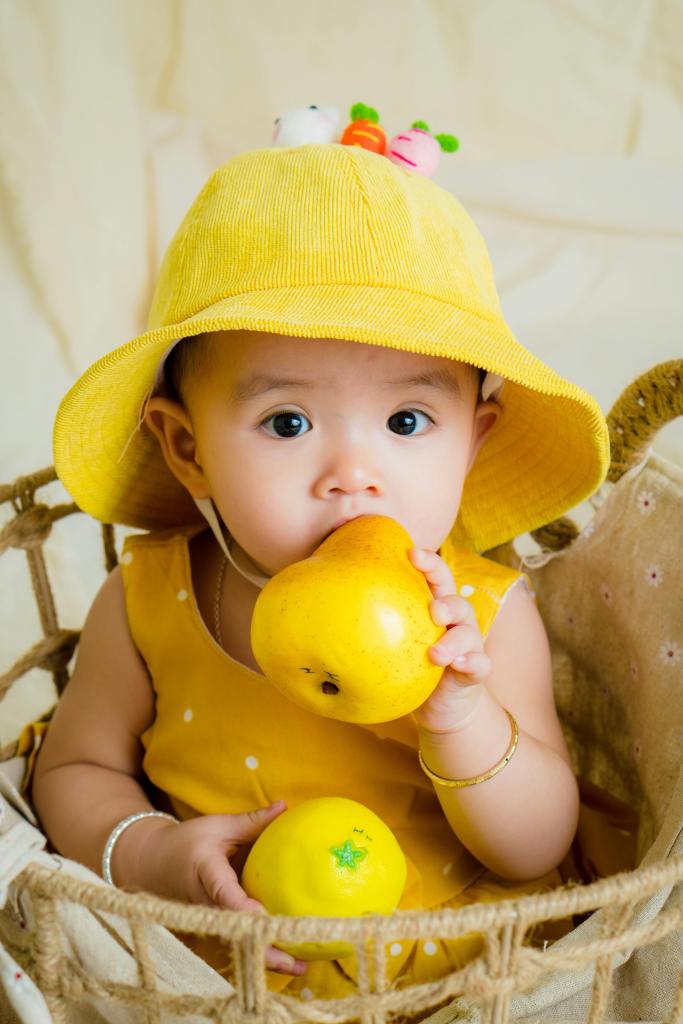
From infancy, we can support this by offering toys and materials that are realistic and grounded in everyday life. A soft doll with balanced features, a wooden bird mobile that resembles real species, or a plus cow that looks like the ones on the farm. All these create meaningful associations between objects and words.
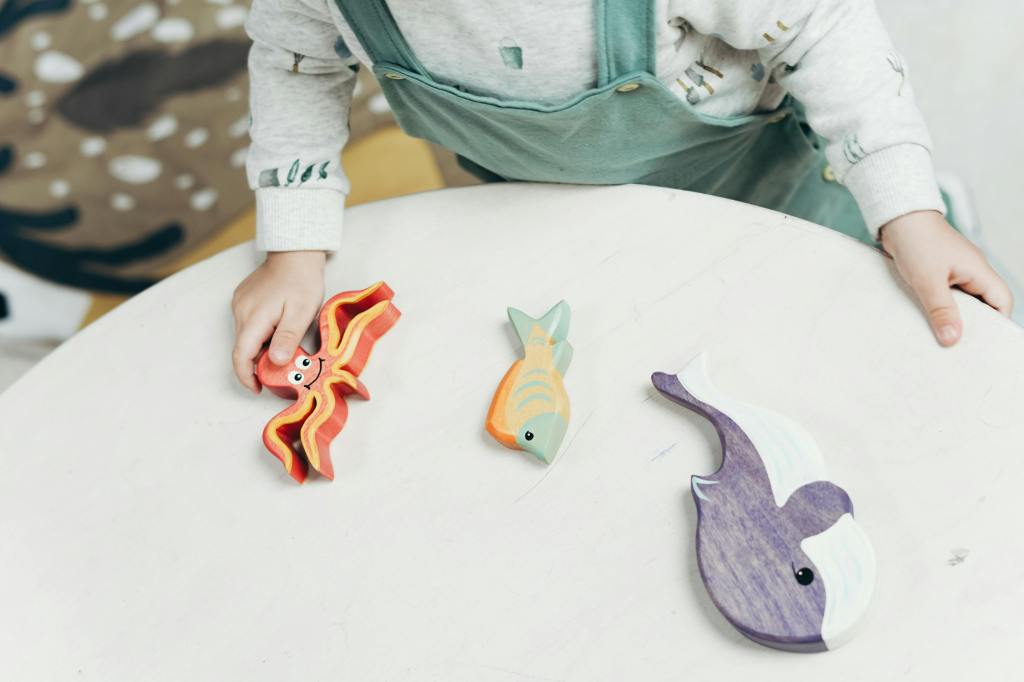
Around 18 months, children’s fine motor skills become more developed. they start exploring their surroundings with more intention. This is the perfect time to begin symbolic play with miniature objects: fruits, tools, animals, furniture, or utensils.
A Practical Approach to Introducing Language Through Objects
Here is a step-by-step Montessori method you can use at home:
- Start with a theme basket: Choose 3-5 objects from the same category (e.g: kitchen items, animals, vegetables).
- Present the items slowly: Name each item clearly while placing it left to right on a small rug or table.
- Playing a naming game: Say the name of an object repeatedly, and then ask your child to hand it to you.
- Match with picture cards: First, use exact image-object pairs. Later, introduce cards that are similar but not exact to encourage abstract thinking.
- Advance to symbolic games: Eventually, play with cards alone. Your child must now recall the associated object from memory, a key sign of cognitive development.
Gentle Tip: This is a lesson. It is Play. Your role is to model curiosity, not to test or quiz. Let it be joyful for both you and your child.
Realistic Books and Early Literacy
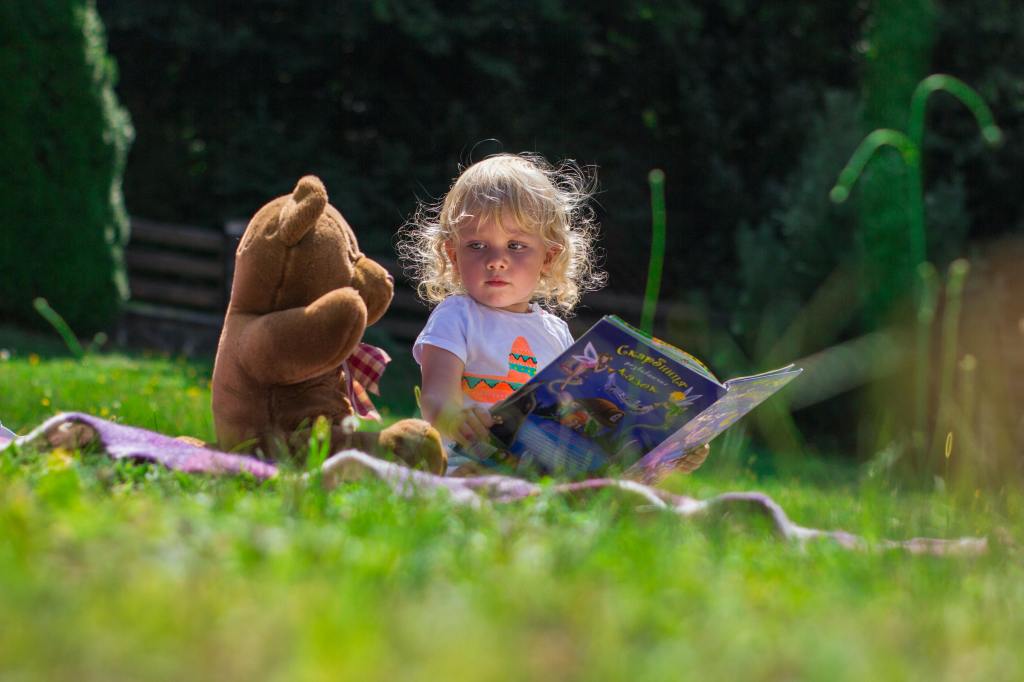
Books open new doors to language and thought. But not all books are equally beneficial in early childhood. Montessori advises starting with books grounded in reality, not fantasy. While imagination is essential later on, a young child needs to first understand the real world: animals that moo, not talk, babies that crawl, not fly.
Guidelines for Creating a Montessori-Friendly Reading Space
- Choose durable books with thick pages for toddlers to handle independently.
- Limit the number of books available at one time: 2-4 books are enough for a toddler.
- Place them in small baskets throughout the home. Important: Not mixed in with toys.
- Store a hidden stash of beautiful books in a cupboard to bring out during special reading times.
- Teach your child from the beginning to handle books with care, turning pages gentle and starting from the top.

Daily Reading Rituals
Make reading time sacred. Here are some principles to follow:
- The emotional interaction between your child and you is the most memorable aspect of your reading time together. It is, therefore, important that you make this experience enjoyable for you as well as your child.
- Choose books that you find interesting. Your children are not likely to grow up loving reading if they associate it with parental boredom or a compulsory parental duty.
- Stick to a set reading time to create healthy bedtime routines.
- Avoid the “one more page” trap to delays bedtime.
- Let your child choose between a few books. If they always want control, it is okay to set boundaries. Lovingly clarify that you should be the one who selects the book.
- Most importantly, let your child see you reading. When parents read for pleasure, children learn that books are valuable.
- During the first months, it is not difficult to read in front of your child. However, when the child is more mobile, set aside a designated time for your own reading. It is beneficial to have a dedicated daytime reading time.
- During this time, make a conscious decision not to respond to the child. Respond only if he is getting himself into a dangerous situation.
Even if your child does not understand every word, they are absorbing tone, rhythm, vocabulary, and expressive thought. They are all essential ingredients for their language development.

Balancing Exposure and Respect
Children vary greatly in how quickly they develop language. Some speak in full sentences at two. Others take more time. Be patient, and avoid labeling your child as “slow” or “gifted”. Montessori’s approach teaches us to observe without judgment and respond to what the child needs in the moment.
Rather than rushing to teach, aim to enrich your child’s environment with sensory variety, emotional warmth, real-life vocabulary, and meaningful routines. These are the ingredients that awaken both language and intelligence.
Language is not a subject to teach. It is a way of being, seeing, and loving the world. By offering a rich sensory world, real-life objects, carefully chosen books, adn a peaceful home environment, you are already planting the seeds of deep communication and lifelong learning.



 TrieBios Baby & Mama
Leave a comment